
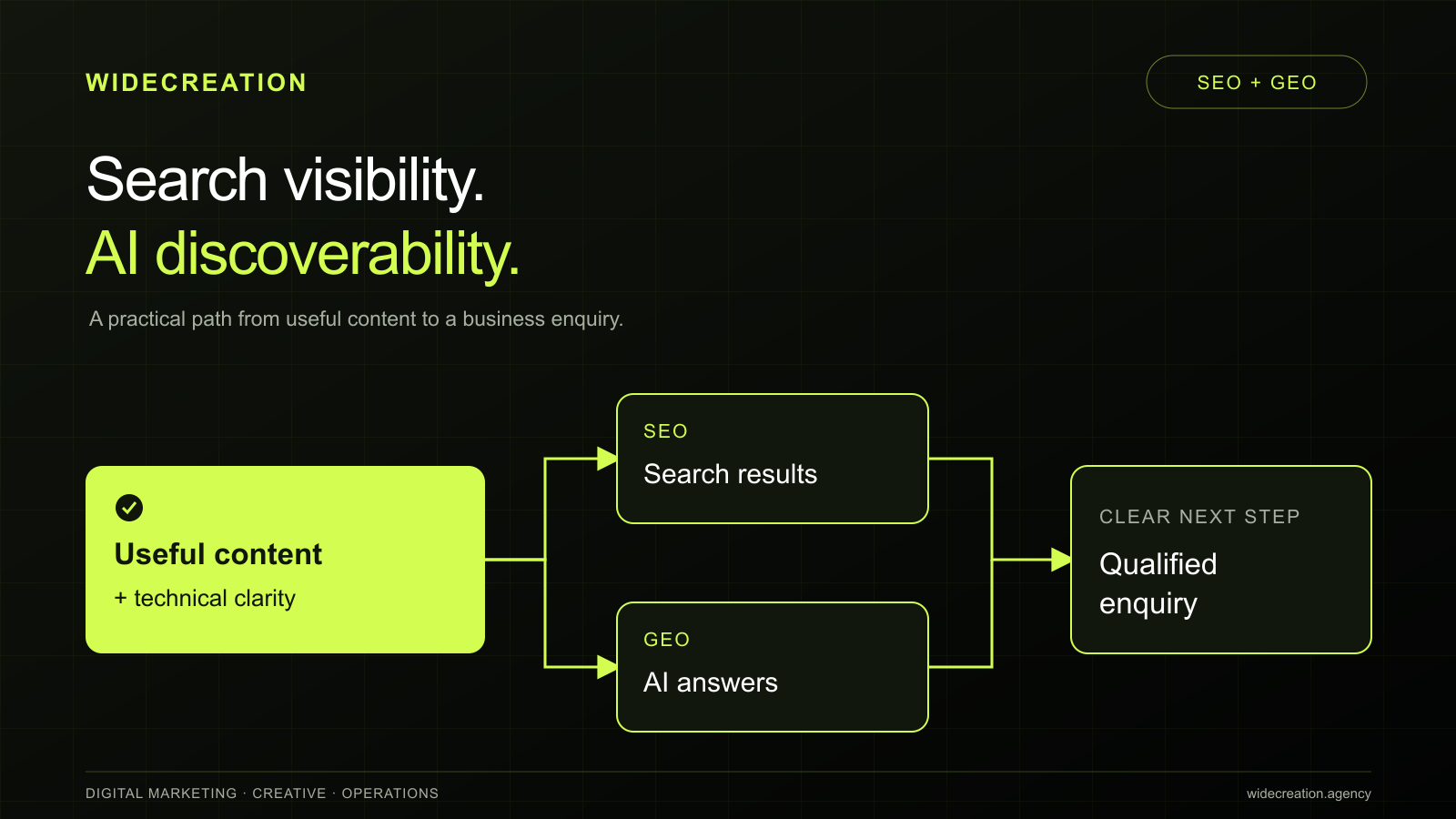
What do SEO and GEO mean?
SEO, or search engine optimisation, helps people discover and use your website through search engines. GEO, or generative engine optimisation, describes efforts to improve visibility in answers generated by AI systems. For a business, the practical aim is to reach relevant buyers with accurate information and help them take the next step.
Google says its generative search experiences still depend on established SEO principles. There is no special AI file or schema that guarantees inclusion. A sound strategy therefore starts with an accessible website, useful expertise and an offer people understand. Treat AI visibility as another discovery channel within your marketing plan.
Start with the questions that influence a purchase
Choose one service and identify the decisions a buyer must make before contacting you. Review genuine sales conversations, support requests and available search data. Group questions by intent: understanding a problem, comparing approaches and choosing a provider. Use the language customers use; keyword tools can help validate demand once reliable data is available.
For example, a hypothetical retailer considering an online store might ask about platform choice, product photography and order fulfilment. One practical guide can connect these decisions. Separate service pages should explain what is delivered and for whom. This example illustrates a planning method; it is not a WIDECREATION client case or a claim about search volume.
Fix discovery and indexing before expanding content
Check that priority pages return a successful response, are accessible without login and expose their main text to crawlers. Review robots rules, accidental noindex directives, canonical URLs, mobile usability and sitemap entries. A published page needs a discoverable route from relevant navigation or another page. A sitemap supports discovery; it does not replace internal navigation.
For Google's AI search features, pages must be indexed and eligible to appear with a snippet. Meeting these technical eligibility requirements does not guarantee indexing or selection. Keep publication workflows consistent: drafts and future articles should remain unavailable until their publication time, then appear in navigation and the sitemap.
Answer clearly and add evidence readers can use
Give a direct answer near the beginning, then explain the conditions, trade-offs and next steps. Add material your team can substantiate: an original workflow, a labelled demonstration, a checklist or a documented example used with permission. Describe what was actually done. If results are unavailable, explain the process without inventing numbers or implying a successful outcome.
Google's helpful content guidance emphasises original value, reliable sourcing and a satisfying answer for the intended audience. Put that into practice by having someone familiar with the service review the article. Update it when the underlying information changes, and disclose limitations that affect a buying decision.
Use links to connect a useful decision path
Link an article to the service that can solve the problem it discusses, and to another guide when readers need a deeper explanation. Use descriptive text that explains the destination. Google's link guidance recommends crawlable links with meaningful anchors. Add external sources where they substantiate a claim, rather than filling every paragraph with links.
A search strategy also needs a sensible place within the wider acquisition mix. Our guide to balancing paid media, SEO and conversion optimisation helps frame that decision. For external visibility, pursue contributions worth referencing: practical research, expert interviews or useful partnerships. Buying mentions or exchanging unrelated links can undermine trust.
Make your business and expertise easy to verify
Keep the business name, services, contact details and relevant profiles consistent. Explain who is responsible for the content using real authorship or an honest editorial attribution. Avoid fabricated credentials, awards and testimonials. Supporting visuals should clarify the subject: a process diagram or annotated example is more useful than an image with no relationship to the answer.
Where applicable, use structured data to describe the article and organisation accurately. It should match visible information. Google's structured data documentation explains its role in understanding content and eligibility for rich results. Validate the implementation, but do not present a successful validation as proof of rankings or AI citations.
Connect discovery to a useful next step
A relevant visitor needs to understand your offer before completing a form. Show the service scope, delivery process, useful examples and what happens after an enquiry. Keep the call to action appropriate to the article. A reader comparing approaches may need a diagnostic conversation before requesting a proposal.
Marketing, design and operations should support the same journey. Digital marketing connects audience research, acquisition and measurement; creative production helps explain the offer visually. Assign an owner to handle enquiries, record lead quality and feed recurring questions back into the editorial plan.
Measure AI visibility and commercial outcomes separately
In a verified property, review Google's Generative AI performance report for AI Overviews and AI Mode impressions where available. Google notes that the report may be absent when impressions are insufficient; these data also form part of Web performance. An impression means exposure, not a visit or a qualified lead.
Bing AI Performance reports citations across supported Microsoft and partner experiences. Its citation counts do not indicate ranking or placement. Use these platform reports within their stated scope. Manual prompt checks can provide examples, but responses change and a small sample cannot establish overall visibility.
Track completed enquiries, qualified leads and sales alongside organic visits. Compare equivalent periods and annotate site changes; seasonality and other campaigns can affect results. Our guide to marketing and creative performance KPIs explains how to choose measures that support decisions.
A practical 30-day plan
Week 1: select one commercially relevant topic. Audit its service page, related articles and indexing status. Record a baseline for visibility, enquiries and lead quality. Agree who approves content and who handles technical changes.
Week 2: improve one service page and one supporting guide. Answer real buyer questions, add verifiable evidence and remove vague promises. Commission a useful diagram or demonstration if it helps explain the decision.
Week 3: review titles, descriptions, internal links, image alternatives and structured data. Test the page on mobile, the contact form and enquiry routing. Publish only after editorial and technical review.
Week 4: inspect discovery and available performance data. Address obvious issues, document what changed and plan the next useful topic. Thirty days is an implementation cycle, not a guaranteed timetable for rankings, citations or sales.
Frequently asked questions about SEO and GEO
Does GEO replace SEO? For Google Search, established SEO remains the foundation of generative visibility. Other platforms have their own retrieval systems and reporting. Start with reliable content and technical access, then evaluate the platforms relevant to your customers.
Can an agency guarantee mentions in AI answers? Selection is controlled by the platform and changes with context. A responsible proposal should specify deliverables, measurement methods and limitations, without guaranteeing citations or a universal GEO score.
Should we publish more articles? Publish when there is a useful question to answer and enough evidence to support it. Improving an existing page can be a better use of resources than producing several overlapping posts. Give each page a clear purpose.
Build a strategy your team can maintain
SEO and GEO work best as part of a maintained marketing system: a clear offer, useful content, dependable publishing and a responsive commercial process. Talk to WIDECREATION about reviewing one priority service and its discovery-to-enquiry journey. Bring your business goals, current content and available analytics so the first recommendations address a real decision.